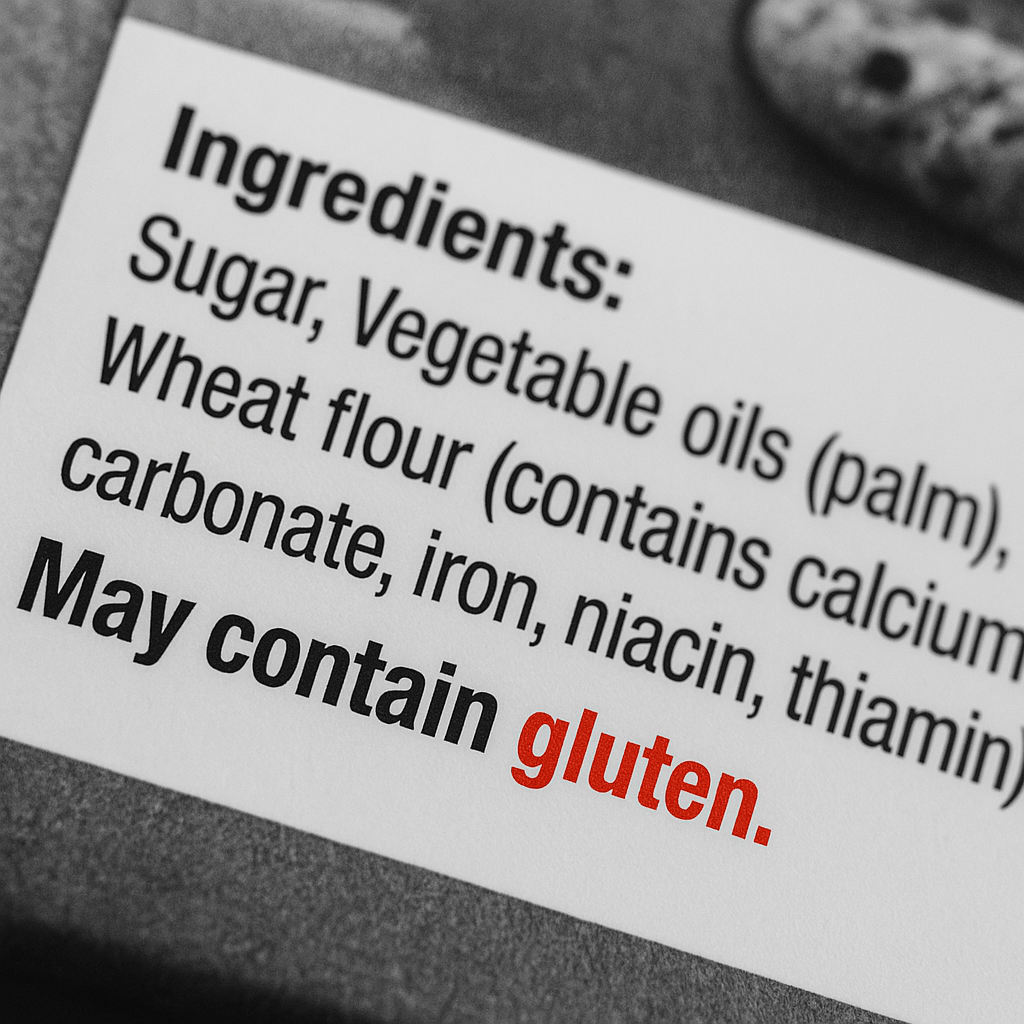
Let’s talk about those three haunting words that strike fear into the gluten-free soul: “May contain gluten.” Or worse—“May contain wheat.” Or even worse than that—“May contain traces of common allergens including gluten, wheat, nuts, sarcasm, and vague labelling laws.”
If you’ve ever stared blankly at a packet of crisps for 20 minutes, wondering whether you’re about to poison yourself or just miss out on a good snack, welcome to the club. Membership is free, the anxiety is high, and the snacks are… questionable.
What “May Contain” Actually Means (And Why It’s So Vague)
The phrase “may contain” is essentially code for: “We’re not entirely sure, so we’re covering our backs.” It’s used when there’s a risk of cross-contamination during production—say, if the factory also handles gluten-containing products. It doesn’t mean the product definitely contains gluten, but it might, and for those of us with coeliac disease, that “might” is a gamble we can’t afford.
It’s frustrating because it’s so non-committal. It’s like your snack is ghosting you. “Are you safe for me?” you whisper. And it just shrugs.
The Legal Bit (A.K.A. Why It’s Not Illegal to Keep Us Guessing)
In the UK, food manufacturers are required to label ingredients that are known allergens—gluten, wheat, milk, nuts, etc.—if they are intentionally added. But precautionary allergen labelling (PAL), like “may contain,” is voluntary. VOLUNTARY. As in, not actually required by law.
So companies can slap that vague little sentence on a label to protect themselves legally, without any actual testing, and leave us to do the emotional heavy lifting. Brilliant.
When to Avoid and When to Proceed (with Caution)
Here’s the tricky bit. Some coeliacs strictly avoid anything with a “may contain” warning. Others take a risk based on the product, the brand, or just sheer desperation after a long day. (We’ve all stared down a packet of chocolate buttons at 10pm and thought, Well, this is how I go.)
General rule of thumb:
- If it says “may contain gluten” or “wheat” – it’s best to avoid.
- If it says “made in a factory that also handles…” – use your judgement, but know it’s a risk.
- If you’re new to coeliac life, play it safe. You don’t want your first rebellion to be over a cereal bar.
When in doubt? Ask the manufacturer—or better yet, don’t. Their customer service email will thank you for your interest and proceed to tell you nothing (well that’s what used to happen, it has got better in recent years).
The Emotional Rollercoaster of Finding a New Favourite Snack, Only to See the Words…
You know the feeling. You discover a snack. It’s delicious. It seems safe. You check the ingredients—no gluten, no wheat. You’re already mentally planning a lifetime commitment. Then you turn the pack slightly and see it: “May contain gluten.”
The betrayal. The heartbreak.
And then, to twist the knife further, someone else in your house—someone with a fully functioning digestive system—eats it in front of you. Smiling. With crumbs on their shirt. Monsters.
Tips for Shopping Without Losing the Will to Live
- Know your brands. Some are better than others when it comes to transparency. Keep a list of your go-to trusted names.
- Use apps and forums. Coeliac UK’s app is handy, and online communities can be a goldmine of info (and solidarity).
- Look for the Coeliac UK Crossed Grain symbol. It’s not a guarantee against “may contain” labelling, but it’s a good sign.
- Don’t shop hungry. You’ll end up rage-buying something questionable and regretting it three hours later on the toilet.
- Take photos of safe items. You won’t remember them next week when you’re staring blankly at the shelves again.
- Remember: it’s not you—it’s the labelling. You’re not paranoid. You’re just trying not to destroy your own gut lining.
At the end of the day, navigating “may contain” labels is part of the coeliac experience—a very annoying, very confusing part. But with a bit of caution, some reliable snacks, and a strong support network (or a passive-aggressive blog), we can survive the minefield.
Now if you’ll excuse me, I’m off to write a strongly worded letter to a crisp manufacturer. Again.


Leave a comment